

100% PASS RATE Project+ PK0-005 Certified Exam DUMP with 83 Questions
Updates For the Latest PK0-005 Free Exam Study Guide!
The CompTIA PK0-005 (CompTIA Project+ Certification) exam is ideal for project managers who are looking to advance their careers or gain industry recognition. It is also suitable for individuals who are new to project management and are looking to gain a foundational understanding of the subject. A CompTIA Project+ certification can open up new career opportunities and help individuals build credibility as project managers.
NEW QUESTION # 41
During a brainstorming meeting, a project manager identifies multiple techniques that will help the project team ensure confidence and alignment with the project scope and goals. Which of the following plans is the project manager creating?
- A. Quality assurance
- B. Procurement
- C. Communication
- D. Risk
Answer: A
Explanation:
Explanation
The project manager is creating a quality assurance plan when identifying multiple techniques that will help the project team ensure confidence and alignment with the project scope and goals during a brainstorming meeting. A quality assurance plan is a plan that defines and documents the standards, criteria, methods, activities, and tools for ensuring and verifying that the quality requirements and expectations of a project are met. A quality assurance plan can help to improve the quality of the project processes and deliverables and prevent or reduce defects or errors.
NEW QUESTION # 42
During a quality analysis review, the causes of several issues have been highlighted. Which of the following should the project manager use to identify the MOST important causes?
- A. Pareto chart
- B. Scatter diagram
- C. Ishikawa diagram
- D. Decision tree
Answer: A
Explanation:
Explanation
The Pareto chart should be used to identify the most important causes of issues during a quality analysis review. The Pareto chart is a graphical representation of the frequency and impact of different causes, helping to identify the most common and impactful causes. References: CompTIA Project+ Study Guide Section 3.3.3
NEW QUESTION # 43
A project manager needs to update the project sponsor and senior stakeholders about the progress of a project.
Which of the following tools will the project manager MOST likely use?
- A. Gantt chart
- B. Work breakdown structure
- C. Dashboard
- D. Requirements Traceability Matrix
Answer: C
Explanation:
Explanation
A dashboard is a tool that the project manager will most likely use to update the project sponsor and senior stakeholders about the progress of a project. A dashboard is a graphical tool that displays key performance indicators (KPIs), metrics, and data related to a project using charts, graphs, tables, or other visual elements. A dashboard can help to provide a quick and easy overview of the project status and performance and highlight any issues or risks that need attention.
NEW QUESTION # 44
Which of the following items must be protected as Pll? (Select TWO).
- A. Job title
- B. Home address
- C. Date of birth
- D. Work phone number
- E. Blood type
- F. Time zone
Answer: B,C
Explanation:
Explanation
Home address and date of birth must be protected as personally identifiable information (PII). PII is any information that can be used to identify, contact, or locate an individual person, either alone or in combination with other sources. PII can include information such as name, email address, phone number, social security number, passport number, driver's license number, bank account number, credit card number, biometric data, medical records, etc. PII must be protected from unauthorized access, use, disclosure, modification, or destruction to prevent identity theft, fraud, or other malicious activities that may harm the individual's privacy or security.
NEW QUESTION # 45
A client provides a project plan to the assigned project manager and suggests that the project manager and team just need to execute the plan. Upon further investigation, the document contains:
* Purpose
* Scope of work
* Location of work
* Period of performance
* Deliverables schedule
* Applicable standards
* Acceptance criteria
* Special requirements
* Payment schedule
Which of the following documents did the client provide to the project manager?
- A. SLA
- B. RFP
- C. WBS
- D. SOW
Answer: D
Explanation:
Explanation
The client provided a statement of work (SOW) to the project manager and suggested that the project manager and team just need to execute the plan. A SOW is a document that defines the scope, deliverables, schedule, and terms and conditions of a project or contract. A SOW typically includes information such as purpose, scope of work, location of work, period of performance, deliverables schedule, applicable standards, acceptance criteria, special requirements, and payment schedule. A SOW can help to establish a common understanding and agreement between the client and the service provider on what needs to be done and how it will be done.
NEW QUESTION # 46
Following a successful release, a project manager sent a survey to all stakeholders to gain an understanding of opportunity areas for the team. Which of the following can use the survey results as an input?
- A. Daily stand-up
- B. Meeting minutes
- C. Project momentum
- D. Performance feedback
Answer: D
Explanation:
Explanation
The project manager can use the survey results as an input for performance feedback for the project team members. Performance feedback is a process of providing constructive and timely information on the performance of individuals or teams in relation to project goals and expectations. Performance feedback can help to motivate, improve, and recognize project team members The survey results can be used as an input for performance feedback. Performance feedback involves analyzing and evaluating the performance of the project team and project management against the project plan, including identifying areas for improvement. The survey results can help identify these areas for improvement and provide feedback to the project team on their performance. References: CompTIA Project+ Study Guide Section 4.1.1
NEW QUESTION # 47
Which of the following should occur when implementing an IT infrastructure change that takes risks into consideration?
- A. Defining requirements
- B. Gathering necessary resources
- C. Approving the change request
- D. Developing a rollback plan
Answer: D
Explanation:
Explanation
When implementing an IT infrastructure change that takes risks into consideration, the project manager should develop a rollback plan. A rollback plan is a contingency plan that outlines the steps that need to be taken in case the change does not work as expected. It includes a plan to roll back the changes and restore the system to its previous state. References: CompTIA Project+ Study Guide Section 3.3.
The project manager should develop a rollback plan when implementing an IT infrastructure change that takes risks into consideration. A rollback plan is a contingency plan that describes how to revert back to the previous state of the system in case of a failure or disruption during the change implementation. A rollback plan can help to minimize the impact of the change on the system performance and availability and ensure business continuity and data integrity.
NEW QUESTION # 48
Which of the following requires the MOST availability from the business team?
- A. PRINCE2
- B. Waterfall
- C. SDLC
- D. Scrum
Answer: D
Explanation:
Explanation
Scrum requires the most availability from the business team among the given options. Scrum is a popular agile framework that organizes work into short iterations called sprints, usually lasting one to four weeks. Scrum emphasizes collaboration between teams, customers, and stakeholders and encourages open communication and transparency throughout the project lifecycle. Scrum requires frequent involvement and feedback from the business team through activities such as product backlog refinement, sprint planning, sprint review, sprint retrospective, and daily scrum meetings.
NEW QUESTION # 49
A PM is working with stakeholders in the discovery phase and comparing the cost of the project to the cost savings the project will produce when it is complete. The output of this exercise will produce the:
- A. SOW.
- B. ROI.
- C. RFI.
- D. RPR
Answer: B
Explanation:
Explanation
The output of this exercise where the project manager is comparing the cost of the project to the cost savings the project will produce when it is complete will produce the return on investment (ROI). ROI is a financial metric that measures the profitability or efficiency of an investment by comparing its benefits or returns to its costs. ROI can help to evaluate the valueor worth of a project and support decision making and prioritization.
ROI is calculated by dividing the net benefits (benefits minus costs) by the total costs and multiplying by 100 to get a percentage.
NEW QUESTION # 50
A critical business initiative introduced new processes and technology to the organization. Which of the following approaches should be used to ensure the deliverables are increasingly adopted and leveraged by the organization over time?
- A. New user kickoff meeting
- B. Monthly feedback and training sessions
- C. Management directives to use the new system
- D. Creation of a social news forum
Answer: B
Explanation:
Explanation
Monthly feedback and training sessions are the best approach to ensure that the deliverables of a critical business initiative are increasingly adopted and leveraged by the organization over time. Feedback and training sessions are communication and learning activities that provide information and guidance on how to use and benefit from the new processes and technology introduced by the initiative. Feedback and training sessions can help to increase awareness, understanding, acceptance, and adoption of the deliverables among the organization's employees and stakeholders. They can also help to identify and address any issues or challenges that may arise during the implementation and transition phases.
NEW QUESTION # 51
In a functional organization, a project has been completed successfully. Which of the following actions would the project manager MOST likely perform?
- A. Notify the functional manager that resources are released.
- B. Assemble a new project with existing resources.
- C. Obtain the final report from release management.
- D. Allocate resources in a different project
Answer: A
Explanation:
Explanation
The project manager should notify the functional manager that resources are released after completing a project successfully in a functional organization. A functional organization is a type of organizational structure where employees are grouped by their functions or specialties, such as finance, marketing, or engineering. In a functional organization, the functional manager has more authority and control over the resources than the project manager. Therefore, the project manager should inform the functional manager when the resources are no longer needed for the project and can be reassigned to other tasks or projects.
NEW QUESTION # 52
A project manager sent equipment to a global project team for testing purposes. Only 70% of the project team received the equipment for testing. Which of the following considerations is impacting the rest of the team?
- A. Country legal regulations
- B. Organizational branding restrictions
- C. Quality assurance
- D. State privacy acts
Answer: A
Explanation:
Explanation
Country legal regulations. Country legal regulations are impacting the rest of the team that did not receive the equipment for testing. Country legal regulations are rules and laws that govern how businesses operate in different countries. They may include aspects such as customs, tariffs, taxes, import and export restrictions, data protection, intellectual property rights, and environmental standards. Country legal regulations can affect the delivery and use of equipment for a global project team and may require compliance with different procedures and documentation3
NEW QUESTION # 53
A project manager has been assigned to a new project. During the planning phase, the project manager needs to get an understanding of the purpose of the project. Which of the following should the project manager do?
- A. Perform a gap analysis.
- B. Review existing artifacts.
- C. Collate the lessons learned.
- D. Conduct a retrospective.
Answer: B
Explanation:
Explanation
The project manager should review existing artifacts to get an understanding of the purpose of the project.
Existing artifacts are documents or records that provide information about the project background, context, scope, objectives, requirements, stakeholders, and deliverables. They may include documents such as project proposal, project charter, business case, feasibility study, statement of work (SOW), or contract. Reviewing existing artifacts can help to clarify the project vision and expectations and provide a basis for planning and executing the project.
NEW QUESTION # 54
By developing a project schedule, a PM has already validated the constraints, outlined the duration of the tasks and the phases, and confirmed the proper sequence and flow of the project. Which of the following activities still needs to be performed to complete the schedule?
- A. Establish baselines.
- B. Develop a communication plan.
- C. Allocate resources.
- D. Determine the project budget
Answer: A
Explanation:
Explanation
The next step after defining tasks, durations, resources, and costs is to establish baselines. A baseline is an approved version of a project plan that serves as a reference point for measuring progress and performance throughout the project lifecycle. A baseline typically includes scope, schedule, cost, quality, and risk parameters. Establishing baselines involves presenting the project plan to key stakeholders and obtaining their formal agreement on the project objectives and deliverables. Baseline approval can help to establish clear expectations, avoid scope creep, and facilitate change control during project execution34
NEW QUESTION # 55
Defects associated with project deliverables have been reported. The project team needs to find the cause of the defects. Which of the following tools should the project team use to find the cause?
- A. Kanban board
- B. Ishikawa diagram
- C. Pareto chart
- D. Decision tree
Answer: B
Explanation:
Explanation
An Ishikawa diagram is a tool that the project team should use to find the cause of the defects associated with project deliverables. An Ishikawa diagram, also known as a fishbone diagram or a cause-and-effect diagram, is a graphical tool that shows the possible causes of a problem or effect using a fishbone-like structure. An Ishikawa diagram can help to identify and analyze the root causes of defects or issues and find solutions to prevent or eliminate them.
NEW QUESTION # 56
As part of the planning phase, a PM has defined tasks, durations, resources, and costs. Which of the following is the NEXT step in the process?
- A. Update the work breakdown structure.
- B. Seek baseline approval.
- C. Establish the resource pool.
- D. Review the backlog.
Answer: B
Explanation:
Explanation
The next step in the process after defining tasks, durations, resources, and costs is to seek baseline approval. A baseline is an approved version of a project plan that serves as a reference point for measuring progress and performance throughout the project lifecycle. A baseline typically includes scope, schedule, cost, quality, and risk parameters. Seeking baseline approval involves presenting the project plan to key stakeholders and obtaining their formal agreement on the project objectives and deliverables. Baseline approval can help to establish clear expectations, avoid scope creep, and facilitate change control during project execution.
The NEXT step after defining tasks, durations, resources, and costs during the planning phase is to seek baseline approval. Baseline approval involves finalizing the project plan and gaining approval from stakeholders, establishing the plan as the baseline for the project's performance. References: CompTIA Project+ Study Guide Section 3.4.1
NEW QUESTION # 57
A project sponsor asked the PM to provide a summary of the current financial status. The PM uses the following burn up chart for the analysis: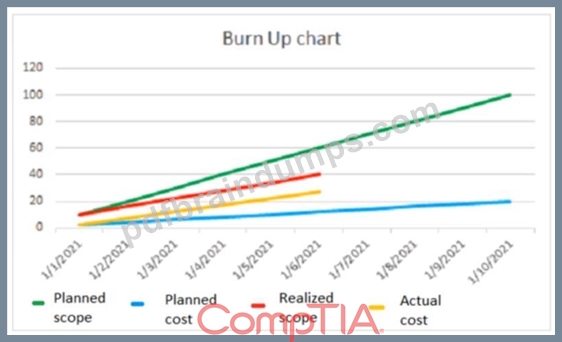
Based on the chart, which of the following is the current status of the project?
- A. Behind schedule and under budget
- B. Ahead of schedule and over budget
- C. Ahead of schedule and under budget
- D. Behind schedule and over budget
Answer: D
Explanation:
Explanation
The project manager can use the burn up chart to analyze the current status of the project based on its scope (value delivered), budget (cost), and schedule (time). A burn up chart is a graphical tool that shows how much work has been completed (burned up) versus how much work remains (scope) over time. It also shows how much budget has been spent (burned up) versus how much budget remains (budget) over time. A burn up chart can help to monitor and control the project progress and performance and identify any variances or deviations from the plan. The chart given shows that both scope and budget lines are above their respective target lines at any given time point. This means that less work has been completed than planned (scope variance) and more money has been spent than planned (budget variance) at any given time point. Therefore, the project is behind schedule and over budget.
NEW QUESTION # 58
A financial manager reports that several employees' allocations from the past month appear to be 200% even though they are only assigned to a particular project. Which of the following could MOST likely be the cause of this issue?
- A. A project manager assigned the wrong resources.
- B. A project manager did not provide the project sign-off.
- C. A project manager did not remove the system access.
- D. A project manager did not release the resources
Answer: D
Explanation:
Explanation
A project manager did not release the resources. A project manager not releasing the resources could most likely be the cause of this issue where several employees' allocations from the past month appear to be 200% even though they are only assigned to a particular project. Releasing resources is a process of freeing up or reallocating any human or material resources that were used for a project after its completion or closure.
Releasing resources can help to update the resource availability and utilization records and avoid any conflicts or errors in resource allocation or reporting.
NEW QUESTION # 59
An institution wants to implement software solutions to help manage the internal flow for formally responding in writing to citizens' complaints. Which of the following solutions would be BEST?
- A. Customer relationship management and databases
- B. Content management and financial systems
- C. Enterprise resource planning and end user applications
- D. Electronic document and record management systems
Answer: D
Explanation:
Explanation
Electronic document and record management systems would be the best software solutions to help an institution manage the internal flow for formally responding in writing to citizens' complaints. Electronic document and record management systems are software systems thathelp organizations create, store, organize, manage, track, and distribute electronic documents and records. Electronic document and record management systems can help to improve efficiency, productivity, collaboration, compliance, and security of document and record management processes and workflows
NEW QUESTION # 60
A project manager was not part of a contract negotiation. The project manager is concerned that stakeholders will expect the project to achieve deliverables requested in the RFP Which of the followingdocuments should the project manager produce FIRST to start communication about the boundaries of the project?
- A. Project charter
- B. Work breakdown structure
- C. Milestone chart
- D. Detailed scope statement
Answer: A
Explanation:
Explanation
The project manager should produce a project charter first to start communication about the boundaries of the project. A project charter is a document that formally authorizes a project and defines its high-level scope, objectives, assumptions, constraints, stakeholders, roles and responsibilities, and key deliverables. A project charter can help to communicate the project vision and expectations to all stakeholders and provide a basis for future project decisions23
NEW QUESTION # 61
......
Best PK0-005 Exam Preparation Material with New Dumps Questions https://www.pdfbraindumps.com/PK0-005_valid-braindumps.html
Fast Exam Updates PK0-005 dumps with PDF Test Engine Practice https://drive.google.com/open?id=1vw0cboldNYFtQfm-JBHYcDZmFZzbBT-J