

PK0-005 Questions Pass on Your First Attempt Dumps for Project+ Certified
PK0-005 Practice Test Pdf Exam Material
CompTIA PK0-005 exam is a certification exam offered by CompTIA, a leading provider of IT certifications. It is designed for individuals who are interested in pursuing a career in project management or are already working in the field and looking to enhance their skills and knowledge. PK0-005 exam covers a range of project management concepts and techniques, including project initiation, planning, execution, monitoring and controlling, and project closure.
CompTIA Project+ Certification Exam is suitable for professionals who are interested in project management or who are already working in the field. CompTIA Project+ Certification Exam certification is vendor-neutral, which means that it is not tied to any particular technology or software. This makes the certification relevant and valuable to professionals across different industries. CompTIA Project+ Certification Exam certification exam is designed to test the knowledge and skills required to manage a project from start to finish, including project planning, execution, monitoring, and closing.
NEW QUESTION # 194
Which of the following can be inferred?
- A. Task B needs to be finished before task C starts.
- B. The project is over budget and behind schedule.
- C. The project will be completed on time.
- D. Task D must be reworked.
Answer: A
Explanation:
The only option that can be reliably inferred in a typical project chart/diagram context (e.g., a network diagram or dependency view) is a dependency relationship-specifically that Task B must finish before Task C can start (a Finish-to-Start relationship). In CompTIA Project+ objectives, dependency management is a core scheduling concept: identifying predecessors/successors and understanding how sequencing drives the schedule. Inference about task ordering is exactly what dependency visuals are designed to communicate.
The other options require information that is not inherently inferable without additional data. "Completed on time" (A) would require schedule baseline vs. forecast/critical path analysis. "Task D must be reworked" (B) would require quality/validation results or defect/issue information. "Over budget and behind schedule" (D) would require performance metrics such as EVM or cost/schedule variance and cannot be concluded solely from a dependency relationship.
So, the best inference is the sequencing rule: B must be completed before C begins, which is a fundamental scheduling/dependency concept emphasized in Project+ planning and schedule control practices.
NEW QUESTION # 195
A principle states 80% of the issues are the result of 20% of the causes. Which of the following types of diagrams is based on this principle?
- A. Scatter
- B. Network
- C. Pareto
- D. Fishbone
Answer: C
Explanation:
The Pareto Principle, or the 80/20 rule, is often represented by a Pareto chart, which is used to prioritize issues by showing the most significant factors. CompTIA Project+ recommends Pareto analysis as a valuable tool for quality control and decision-making.
NEW QUESTION # 196
A project manager is organizing and running a project closure meeting. Which of the following best describes
the objective of this meeting?
- A. To formalize the end of the contract
- B. To obtain project sign-off
- C. To release resources
- D. To move the system to a production environment
Answer: B
Explanation:
A project closure meeting is a formal gathering held at the end of a project timeline. Its chief purpose is to
evaluate the project's performance, identify and discuss the achieved outcomes, successes, and challenges, and
confirm that all predefined tasks and objectives have been completed successfully1. The project closure
meeting also involves obtaining project sign-off from all necessary parties, such as the project sponsor, the
client, the stakeholders, and the team members. Project sign-off is the official approval that the project has met
the agreed-upon criteria and quality standards, and that the project is formally closed2.
NEW QUESTION # 197
Which of the following is a disadvantage of a cloud model?
- A. Longer latency time
- B. Limited expansion capability
- C. Higher dependency on the vendor
- D. Limited processing and storage capacity
Answer: C
Explanation:
A common disadvantage of cloud models is higher dependency on the vendor-often described as vendor lock-in. When solutions rely on a provider's proprietary services, APIs, data formats, or managed offerings, switching providers (or moving back on-premises) can become costly and complex. This dependency can reduce portability and negotiating leverage over time, and it can increase switching costs if pricing, service levels, or strategic needs change.
Options A and B are generally the opposite of typical cloud benefits: cloud platforms usually provide elastic scaling and abundant capacity relative to on-prem constraints (assuming budget allows). Latency (C) can be a disadvantage in some architectures, but it isn't as consistently defining as vendor dependence-latency can be mitigated through region selection, edge services, and network design, and many workloads experience acceptable performance. Vendor dependency/lock-in, however, is a well-known structural risk of adopting cloud-native services.
From a project management lens, this matters in planning and governance: procurement strategy, architectural choices, and exit/migration planning help manage the risk of over-dependence on a single provider.
NEW QUESTION # 198
Halfway through a project, the sponsor states that the project is taking too long to complete. Which of the following should the project manager consult?
- A. Test results
- B. Gantt chart
- C. Maintenance window schedule
- D. Functional requirements
Answer: B
Explanation:
Explanation
The project manager should consult a Gantt chart after the sponsor states that the project is taking too long to complete. A Gantt chart is a graphical tool that shows the schedule of a project, including the start and end dates, durations, dependencies, milestones, and progress of each task or activity. A Gantt chart can help to monitor and control the project timeline and identify any delays, variances, or issues that may affect the project completion.
NEW QUESTION # 199
While working with a contractor, the project manager identified a communication conflict.
The contractor did not agree that there was an issue.
Which of the following should the project manager and contractor review?
- A. Vendor rules of engagement
- B. Scope of work
- C. Project schedule
- D. Request for proposal
Answer: A
Explanation:
The project manager and contractor should review the vendor rules of engagement, which are the guidelines and expectations for the communication and interaction between the project team and the contractor. The vendor rules of engagement can help to prevent or resolve communication conflicts by clarifying the roles and responsibilities, the frequency and mode of communication, the escalation process, the feedback mechanism, and the performance evaluation criteria of the contractor. The vendor rules of engagement are usually part of the contract or the procurement management plan.
The vendor rules of engagement are different from the scope of work, which is the document that describes the work to be performed, the deliverables to be provided, and the acceptance criteria to be met by the contractor. The vendor rules of engagement are also different from the request for proposal, which is the document that solicits proposals from potential contractors by specifying the project requirements, evaluation criteria, and contract terms. The vendor rules of engagement are also different from the project schedule, which is the tool that displays the planned start and finish dates, durations, dependencies, and resources of the project activities and tasks. References = CompTIA Project+ Study Guide: Exam PK0-005, 3rd Edition, Chapter 12: Procurement Management1; CompTIA Project+ Certification Study Guide, 3rd Edition, Chapter
12: Procurement Management2; Vendor Rules of Engagement3
NEW QUESTION # 200
Which of the following activities would be performed during the project closure phase when the waterfall methodology is being used? (Select two).
- A. Updating the issue log
- B. Validating the deliverables
- C. Managing the quality of deliverables
- D. Performing a risk assessment
- E. Reconciling the project budget
- F. Creating a backlog
Answer: B,E
Explanation:
During the project closure phase in the waterfall methodology, it is crucial to validate the deliverables to ensure that all project requirements have been met and the project outputs are complete and satisfactory.
Additionally, reconciling the project budget is performed to ensure all financial records are accurate and reflect the actual project costs, which is essential for the formal closing of the project.
References = CompTIA Project+ Certification Study Guide (PK0-005)
NEW QUESTION # 201
During a gate review meeting, the deliverable was rejected by the customer.
INSTRUCTIONS
Review the dashboard.
* Part 1: Drag and drop each task, placing them in the correct order based on the project change control process.
* Part 2: Select the proper document(s) to be updated.
If at any time you would like to bring back the initial state of the simulation, please click the Reset All button.
Part 1: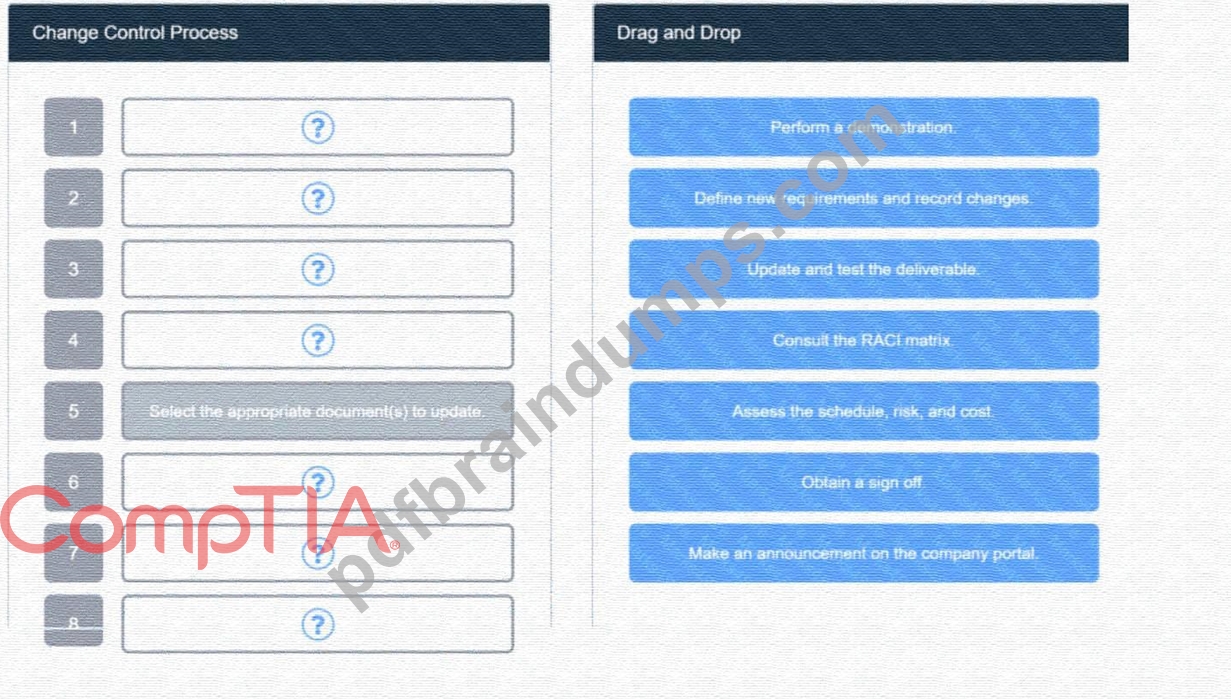
Part 2: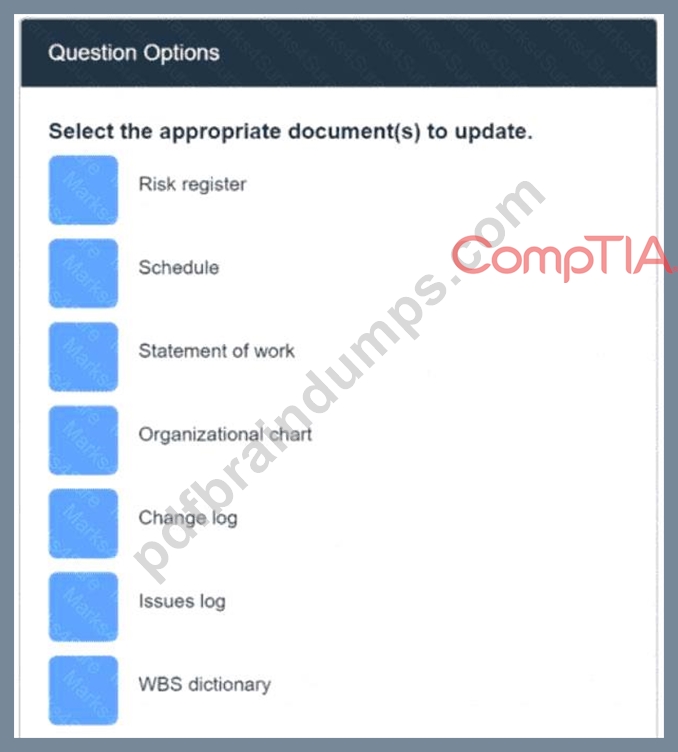
Answer:
Explanation:
See the Explanation for the solution.
Explanation:
Part 1:
Change Control Process:
Consult the RACI matrix.
Define new requirements and record changes.
Assess the schedule, risk, and cost.
Perform a demonstration.
Obtain a sign off.
Update and test the deliverable.
Make an announcement on the company portal.
The change control process is a sequence of steps that helps to manage and document any changes or modifications to a project scope, schedule, cost, quality, or resources. The change control process typically involves the following steps:
Consult the RACI matrix. A RACI matrix is a tool that defines and clarifies the roles and responsibilities of each team member for each task or activity in a project. RACI stands for responsible, accountable, consulted, and informed. Consulting the RACI matrix can help to identify who needs to be involved or informed about the change request and how to communicate with them.
Define new requirements and record changes. The new requirements and changes are the details of what needs to be modified or added to the project deliverables or objectives based on the customer feedback or request. Defining and recording the new requirements and changes can help to communicate and justify the need and rationale for the change and its implications on the project scope and quality.
Assess the schedule, risk, and cost. The schedule, risk, and cost are the aspects of the project that may be affected by the change request. Assessing the schedule, risk, and cost can help to determine the impact and feasibility of the change and identify any possible alternatives or corrective actions to minimize or avoid its negative effects.
Perform a demonstration. A demonstration is a presentation or show of how the modified or updated deliverable works or meets the customer expectations or requirements. Performing a demonstration can help to validate and verify that the change request has been implemented correctly and effectively and to obtain feedback or approval from the customer or stakeholders.
Obtain a sign off. A sign off is a formal acceptance and approval of the change request and its deliverables from the customer or stakeholders. Obtaining a sign off can help to confirm that the change request has been completed successfully and satisfactorily and to close the change control process.
Update and test the deliverable. The deliverable is the product or service that is produced or provided by the project. Updating and testing the deliverable can help to ensure that it meets the quality standards and criteria and that it works as expected after implementing the change request.
Make an announcement on the company portal. The company portal is a platform or channel that allows internal communication and collaboration among employees within an organization. Making an announcement on the company portal can help to inform and update other team members or departments about the change request and its outcomes and to share any lessons learned or best practices from the change control process.
Part2:
Risk register: A risk register is a document that identifies, analyzes, and records the potential risks or uncertainties that may affect a project. Updating the risk register can help to capture any new or modified risks that may arise from the change request and to plan and implement appropriate risk responses.
Schedule: A schedule is a document that shows the planned start and end dates, durations, dependencies, and progress of each task or activity in a project. Updating the schedule can help to reflect any changes or adjustments to the project timeline or milestones that may result from the change request and to monitor and control the project performance and delivery.
Statement of work: A statement of work (SOW) is a document that defines the scope, deliverables, schedule, and terms and conditions of a project or contract. Updating the SOW can help to document any changes or additions to the project scope or deliverables that may be requested or agreed upon by the customer or stakeholders and to ensure alignment and agreement on what needs to be done and how it will be done.
Change log: A change log is a document that tracks and records any changes or modifications that are made to the project scope, schedule, cost, quality, or resources during a project. Updating the change log can help to document the change request, approval, implementation, and impact of each change and ensure traceability and transparency.
NEW QUESTION # 202
During the execution phase of a project, the project team faced an unexpected website downtime The project manager how a brainstorming session and the team identified causes and effects tor the problem Now the project team needs to analyze and determine whether the particular cause and effect are related by using one of the following charts. Which of the following should the team use?
A)
B)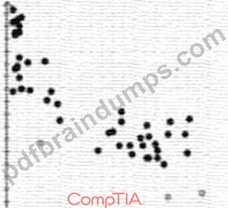
C)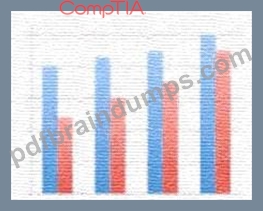
D)
- A. Option B
- B. Option D
- C. Option C
- D. Option A
Answer: D
Explanation:
Option A shows a cause and effect diagram, also known as a fishbone diagram or an Ishikawa diagram1. This is a tool that helps to identify and analyze the root causes of a problem by displaying the possible causes and effects in a graphical format2. A cause and effect diagram can help the project team to determine whether the particular cause and effect are related by using a systematic and logical approach, such as asking "why" questions or using the 5 Whys technique34. A cause and effect diagram is better than the other options because:
Option B shows a Gantt chart, which is a tool that helps to plan and track the tasks, dependencies, durations, and resources of a project along a timeline5. A Gantt chart does not focus on the causes and effects of a problem, but rather on the sequence and progress of the project activities.
Option C shows a pie chart, which is a tool that helps to compare and visualize the proportions of different categories or segments of data6. A pie chart does not show the relationships between the causes and effects of a problem, but rather the distribution of the data values.
Option D shows a scatter plot, which is a tool that helps to examine the correlation or association between two variables or sets of data7. A scatter plot does not show the causes and effects of a problem, but rather the pattern or trend of the data points.
References = CompTIA Project+ Certification Study Guide8, CompTIA Project+ Certification Exam Objectives9, Cause and Effect Diagrams for PMP1, Cause and Effect Analysis: Using Fishbone Diagram and
5 Whys2, How to Create a Cause and Effect Diagram3, How to Use Cause and Effect Analysis to Solve Business Problems4, What is a Gantt Chart?5, What is a Pie Chart?6, What is a Scatter Plot?7
NEW QUESTION # 203
A project manager queries stakeholders to identify the right communication channel to be used during the
project life cycle. After reviewing the responses, the project manager reports that 70% of the stakeholders
prefer email communication, and the rest prefer face-to-face communication. The project manager should
update the stakeholder register with:
- A. the preferred project manager's communication channel.
- B. email communication as the preferred communication channel.
- C. the preferred reported communication channel.
- D. the preferred sponsor's communication channel.
Answer: C
Explanation:
This answer is based on the best practice of stakeholder management, which is to identify and document the
communication preferences of each stakeholder or stakeholder group12. The project manager should update
the stakeholder register with the information gathered from the stakeholder analysis, which includes the
preferred communication channel for each stakeholder3. The preferred reported communication channel
reflects the majority preference of the stakeholders, as well as the minority preference of the face-to-face
communicators. The project manager should use this information to plan and execute effective communication
throughout the project life cycle4. References = CompTIA Project+ Certification Study Guide5, CompTIA
Project+ Certification Exam Objectives6, Stakeholder Register in Project Management1, What is a
Stakeholder Register?2, How to Develop a Stakeholder Register3
NEW QUESTION # 204
After determining the appropriate maintenance window, which of the following should occur NEXT in the
operational infrastructure change process?
- A. Approve the test plan.
- B. Develop a rollback plan.
- C. Implement the change.
- D. Notify customers.
Answer: B
Explanation:
The project manager should develop a rollback plan next after determining the appropriate maintenance
window in the operational infrastructure change process. A rollback plan is a contingency plan that describes
how to revert to the previous state of the system or infrastructure in case of a failure or disruption during the
change implementation. A rollback plan can help to minimize the impact and risk of the change and ensure
business continuity and stability.
NEW QUESTION # 205
A PM is working on the schedule for a project that has technical tasks and requires a SME's knowledge. The PM decides the best way to track this project is to have the project lead provide high-level updates. Which of the following is the best tool to track this data?
- A. Gantt chart
- B. Program Evaluation Review Technique chart
- C. Milestone chart
- D. Project organization chart
Answer: C
Explanation:
A milestone chart is a tool that shows the key events or deliverables of a project along a timeline12. A milestone chart is useful for tracking the progress of a project that has technical tasks and requires a SME's knowledge, because it can provide a high-level overview of the project status, without getting into the details of each task or activity34. A milestone chart can help the PM and the project lead communicate the project achievements, challenges, and expectations to the stakeholders, and also identify any potential risks or delays that may affect the project completion56. A milestone chart is better than the other options because:
A Gantt chart is a tool that shows the tasks, dependencies, durations, and resources of a project along a timeline7. A Gantt chart is more detailed and complex than a milestone chart, and may not be suitable for providing high-level updates to the stakeholders8.
A project organization chart is a tool that shows the roles, responsibilities, and reporting relationships of the project team members and other stakeholders9. A project organization chart is not a tool for tracking project data, but rather for defining the project structure and authority10.
A Program Evaluation Review Technique (PERT) chart is a tool that shows the tasks, dependencies, and critical path of a project along a network diagram. A PERT chart is more focused on the sequence and timing of the project tasks, and may not capture the key milestones or deliverables of the project.
References = CompTIA Project+ Certification Study Guide, CompTIA Project+ Certification Exam Objectives, What is a Milestone Chart?1, How to Create a Milestone Chart in Excel in 3 Steps2, Milestone Chart: The Easiest Way to Track Project Milestones3, How to Use Milestones in Project Management4, What is a Gantt Chart?5, Gantt Chart vs Milestone Chart: What's the Difference?6, What is a Project Organization Chart?7, How to Create a Project Organization Chart8, What is a PERT Chart?9, PERT Chart vs Gantt Chart:
What's the Difference?10
NEW QUESTION # 206
A project sponsor requires a system that is capable of providing integrated management of all the business's core functions. Which of the following systems is the project sponsor describing?
- A. CMS
- B. ERP
- C. EDRMS
- D. CRM
Answer: B
Explanation:
ERP (Enterprise Resource Planning) systems are designed to integrate and manage all core functions of a business, such as finance, HR, and supply chain management. This aligns with CompTIA Project+ guidelines on selecting appropriate systems for organizational needs.
NEW QUESTION # 207
During a quality analysis review, the causes of several issues have been highlighted. Which of the following should the project manager use to identify the MOST important causes?
- A. Scatter diagram
- B. Decision tree
- C. Pareto chart
- D. Ishikawa diagram
Answer: C
Explanation:
Explanation
The Pareto chart should be used to identify the most important causes of issues during a quality analysis review. The Pareto chart is a graphical representation of the frequency and impact of different causes, helping to identify the most common and impactful causes. References: CompTIA Project+ Study Guide Section 3.3.3
NEW QUESTION # 208
A client continues to present the project team with additional changes. To help with agreeing upon an expected delivery date, the project manager sets up a meeting with stakeholders. Which of the following should this meeting identify?
- A. Project communication
- B. Project scope
- C. Project objectives
- D. Project budget
Answer: B
Explanation:
This meeting should identify (and re-confirm) the project scope because repeated "additional changes" are classic drivers of scope change/scope creep, and scope is the primary input for setting a realistic delivery date.
In CompTIA Project+ objectives, scope is explicitly treated as a planning-phase activity-e.g., creating a detailed scope statement and defining units of work-which then enables reliable scheduling and estimating.
When stakeholders keep adding changes, the project manager must use the change control process (collect the change requests, assess impacts, determine decision makers/CCB involvement, update the project plan, implement and validate changes, and communicate deployment). Agreeing on an "expected delivery date" requires stakeholders to align on what work is actually included (scope boundaries) so impacts to the schedule can be calculated and accepted.
While budget, objectives, and communication are important, they don't directly resolve the problem created by ongoing additions: without a clarified, agreed scope baseline (what's in vs. out), any delivery date becomes unstable and will continue to slip as new work is introduced.
NEW QUESTION # 209
Which of the following situations would require a project manager to revise the communication plan during a project's execution?
- A. A change is approved that impacts the project schedule and budget
- B. The team is unclear which meetings they should attend
- C. A stakeholder requests some changes to the scope
- D. The test results are not as expected
Answer: B
Explanation:
If team members are confused about which meetings to attend, this indicates a flaw in the communication plan. Revising the plan ensures clear expectations on who participates in which communication events. Scope or schedule changes don't automatically require altering the communication plan.
Reference: CompTIA Project+ PK0-005 - Communication Planning & Updates
NEW QUESTION # 210
......
CompTIA Project+ Certification, also known as the PK0-005 exam, is a renowned certification exam designed to validate the skills and knowledge of project managers. PK0-005 exam helps professionals demonstrate their ability to initiate, manage, execute, monitor, and complete projects efficiently. CompTIA Project+ Certification is a vendor-neutral certification, which means it is accepted by various organizations worldwide. CompTIA Project+ Certification Exam certification exam is an excellent way to showcase one's project management skills and experience, which can lead to better career opportunities and salary packages.
PK0-005 [Jul-2026] Newly Released] Exam Questions For You To Pass: https://www.pdfbraindumps.com/PK0-005_valid-braindumps.html
PK0-005 Answers PK0-005 Free Demo Are Based On The Real Exam: https://drive.google.com/open?id=1HKLkKls1sqtEeaGYsTyoAPWsssldHc0b